- Try This
- Posts
- Try This – 4 Big Shares for the Week
Try This – 4 Big Shares for the Week
Toxins, colonoscopies, alcohol, and more

Dhru Purohit
March 13, 2026
Try This community, today I’m sharing a few things that have been on my mind this week.
High level:
Another reason to stick to the basics and ignore sensational news
The connection between PFAS and rapid aging
The case for colonoscopies
People aren’t drinking alcohol anymore, and that’s a good thing
Shout Out to Our Sponsor BIOPTIMIZERS Who Helps Keep This Newsletter Free

Bloating, heaviness, or that “food just sitting there” feeling isn’t always about what you ate; it’s often about what your body can’t fully break down.
You can eat clean, organic, high-protein meals… and still struggle with digestion.
Here’s why: as we age, our natural production of digestive enzymes can decline, especially protease, the enzyme responsible for breaking down protein. When enzymes are low, food doesn’t break down efficiently, which can lead to discomfort and reduced nutrient absorption over time.
That’s why MassZymes from BIOptimizers have been a staple in my routine for years.
MassZymes is in a class of its own:
🌱 Full-spectrum blend with 18 enzymes to break down proteins, carbs, fats, starches, and fiber
💪 High levels of protease to support protein digestion and muscle recovery
⚡ Supports better nutrient absorption for energy and metabolism
😌 Helps reduce bloating and that heavy post-meal feeling
If you’re investing in high-quality food and strength training, it makes sense to support the system that processes it. And the best part? BIOptimizers backs it with a 365-day money-back guarantee, so you can try it completely risk-free.
BiOptimizers is offering my community 15% off select products and bundles by using the code DHRU at checkout. Just CLICK HERE and use promo code DHRU to get your digestion back on track with MassZymes.
Number 1: Don’t Believe Everything You Read
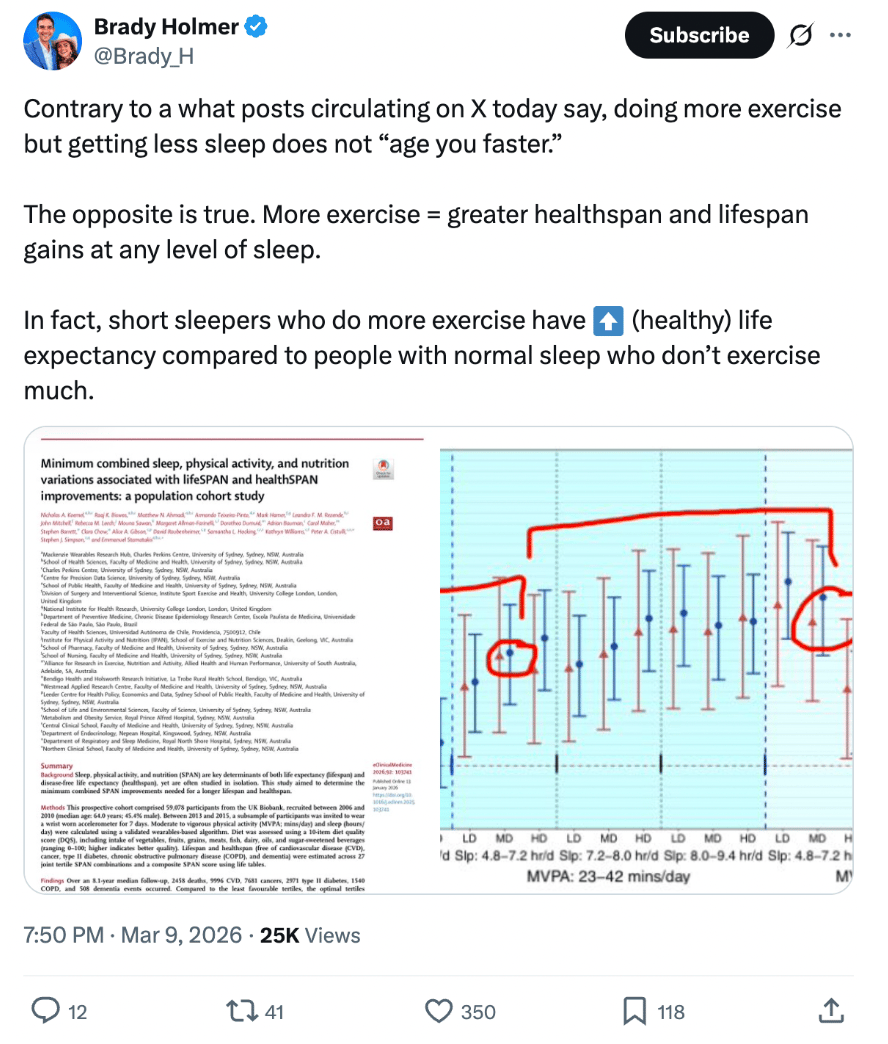
Earlier this week, a study on sleep and physical activity went viral.
Here was the conclusion drawn by some experts: Exercise is only beneficial if you sleep more than six hours a night. If you sleep less than that, exercise can be harmful. 🤔
The study definitely raised a few eyebrows on my team. One minute we’re being told that exercise can help us recover from sleep deprivation, and the next we’re basically being told that we should only exercise if we get a perfect night’s sleep.
Turns out, there were some issues with the way this data was interpreted.
In fact, when you zoom out and look at the total body of evidence that's out there, it's clear that physical activity dramatically impacts the body for the better, even when sleep isn't perfect.
The reason I’m highlighting this is because its a crazy world out there when it comes to health science. Now I’m the first person to say I have zero formal training in this space, which is why it's important to listen to a lot of different voices, especially ones that help balance out viral hot takes.
One voice I follow when it comes to exercise science is Brady Holmer. He’s an elite runner who has an incredible grasp of the evidence. Here are his thoughts on the viral study and why it's so important to prioritize movement:
Number 2: PFAS, aka “Forever Chemicals,” Might Be Making Us Age Faster, Especially Men
Here’s another reason why it matters that we filter our air and water and avoid plastic as much as possible.
PFAS, aka “forever chemicals,” are used in everything from nonstick cookware and food packaging to stain-resistant fabrics and waterproof clothing. The reason they’re called “forever chemicals” is because they don’t break down easily. Once they’re in the environment (or our bodies), they tend to stick around.
A new study looked at blood samples and biological aging markers from 326 adults in the US and found that two PFAS compounds were present in about 95 percent of participants.
What caught researchers’ attention was that people with higher levels of certain PFAS (specifically PFNA and PFOSA) also showed signs of accelerated biological aging. This was particularly true in men aged 50–64.
Biological age reflects how old your body appears at the cellular level, which doesn’t always match the number of birthdays you’ve had. Faster biological aging has previously been linked to higher risks of chronic disease and earlier mortality.
This study adds to a growing body of research suggesting that environmental toxins may influence how fast our bodies age.
Look, I know we can’t avoid these chemicals entirely. And I know that sometimes it feels really annoying to go out of your way to bring your own coffee cup or water bottle, spend money on low-tox cookware, turn on your air filter, or maintain your water filter, but all of that stuff is SO important. Exposure adds up over time, so the small choices you make today can make a huge impact on the way your body ages.
Number 3: Colonoscopies Save Lives
For anyone who is 45 and older or who has a family history of colorectal cancer, listen up. Here’s a good thread on the importance of colonoscopies.

Colorectal cancer is rising at an alarming rate in adults under 50, and unfortunately, it’s something I’ve seen in my own community. I’ve known a couple of people—healthy people—who were diagnosed with colon cancer, and one of them didn’t survive because it was caught too late.
If you care about aging well, a big part of that is catching chronic disease early, and cancer screening is at the top of the list.
The good news is that when colon cancer is detected early, treatment success rates are very high. That’s why screening matters.
In fact, the guidelines have changed: Everyone should now have their first colonoscopy at age 45. If you have a family history of colorectal cancer, it’s recommended to start even earlier: either at age 40 or 10 years before the age your relative was diagnosed, whichever comes first. It’s not the most exciting thing to schedule, but it’s one of the most powerful preventive steps you can take for your long-term health.
Number 4: $25 Poison, Not as Popular
I saw this post the other day, and it really resonated with me (and honestly, most of my friends too). People are drinking less and less, and that’s a good thing.

I started noticing this in my own circles over the last five years or so. Friends who used to have a drink most nights are now choosing alcohol-free options, saving it for special occasions, or skipping it altogether.
And the data backs this up: Alcohol consumption has been steadily declining among younger generations, especially Gen Z, many of whom are choosing moderation or sobriety as part of a broader focus on long-term health. That’s encouraging, because alcohol affects almost every system in the body, from sleep quality and metabolic health to brain aging and cancer risk. Even modest reductions can make a meaningful difference in how you feel day to day.
So if you’re someone who has been experimenting with drinking less (or not drinking at all), you’re definitely not alone. In many ways, it’s becoming one of the quiet health shifts of this generation, and I personally am on board.
See you next week.
Much love,
Dhru Purohit
What did you think about today's email? |
The information in this newsletter is for educational purposes only and should not be construed as medical advice; please consult a qualified healthcare professional before making any health-related decisions.