- Try This
- Posts
- Try This – 3 Big Shares for the Week
Try This – 3 Big Shares for the Week
Alzheimer’s, circadian rhythms, and more

Dhru Purohit
March 20, 2026
Try This community, today I’m sharing a product I’ve been loving, research on why women are more likely to develop Alzheimer’s, and a tip for anyone who has been waking up at two or three in the morning.
Let's get into it.
Shout Out to Our Sponsor Bon Charge Who Helps Keep This Newsletter Free
Most people think hair loss is cosmetic. But it’s often a signaling issue.
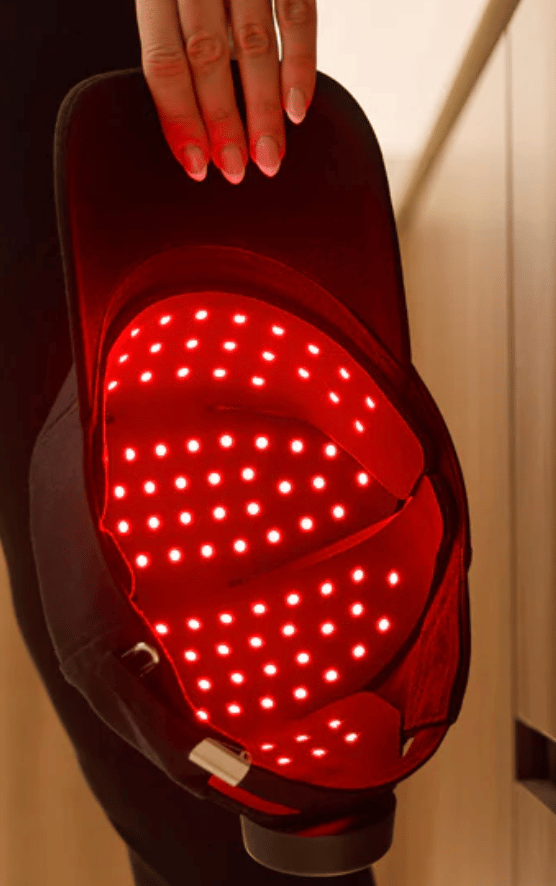
Instead of adding more pills or complicated routines, I look for ways to improve the signal. That’s why the BON CHARGE Red Light Cap has earned a spot in my routine.
Hair follicles are metabolically active tissue. They respond to light, circulation, and mitochondrial energy. When those signals weaken, follicles can shift out of their active growth phase.
The BON CHARGE Red Light Cap uses clinically studied 650nm red light, delivered through 125 LEDs, to support follicle activity at the scalp, where growth begins, while helping promote cellular energy over time.
What I appreciate most is the simplicity.
⏱️ 10 minutes. One button. Done.
✨ Lightweight. Hands-free. Automatic shutoff.
📖 Wear it while reading or answering emails.
🚫🧪 No chemicals. No mess. No extra effort.
✅Just a consistent, science-backed ritual that fits into real life.
For the next 48 hours only, BON CHARGE is offering 20% off their Red Light Cap. Use code TRYTHIS20 at checkout to give your hair (and your scalp) the support they deserve.
Number 1: Why Women Are More at Risk for Developing Alzheimer’s Disease
My friend and past podcast guest, Dr. Lisa Mosconi, just published a major review in the Journal of Clinical Investigation that every woman in midlife needs to know about.
Here is the finding: Women do not get Alzheimer's more than men just because they live longer. That has been the default explanation for decades, and it turns out to be wrong.
Women have their own unique biological risk factors, and the biggest one is something nearly every woman goes through: menopause. It turns out estrogen does a lot more than regulate your cycle. It actively protects your brain, helping to clear out the toxic proteins linked to Alzheimer's.
When estrogen drops at menopause, that protection fades. And here is the part that really got me: This is happening silently, up to 20 years before any memory problems show up.
There are specific risk factors in this paper that most women have never been told about.
Going through menopause before age 45 raises dementia risk by 37 percent.
Having both ovaries surgically removed nearly doubles the long-term risk.
And persistent hot flashes that wake you up at night, or ongoing brain fog that keeps getting worse? Researchers are now recognizing those as potential early warning signs for the brain, not just routine symptoms to push through. Bottom line, your brain will go through changes throughout life, but if your symptoms are persistent and getting worse, getting evaluated is super important.
On hormone therapy, Lisa makes a correction that I think is really important. The famous study that scared an entire generation of women and doctors away from HRT (hormone replacement therapy) enrolled women who were an average age of 71, which means they were already decades past the window where it can actually help.
Newer research suggests that estrogen therapy started closer to menopause—within about 10 years and before age 60—may lower Alzheimer's risk by 11–30 percent.
This is not a blanket recommendation for every woman to go on HRT. What it is is a clear signal that midlife is the window that matters most for brain protection, and that conversation with your doctor should not wait.
Number 2: A Product I’m Using to Support My Circadian Rhythm
I recently bought a few of these circadian-friendly LED lightbulbs for my home, and I’ve been impressed. They are flicker- and dirty-electricity-free and have low-EMF output, with the whole idea being that traditional LEDs are a constant stress on your mitochondria.
My wife laughs because I’m always trying out different lightbulbs. But I’m constantly trying to find the best low-effort lightbulb for day and night. Most of the time, I have to switch out the lightbulb every night, which is super annoying.
But these bulbs are great because they have three light settings on each bulb (daylight, sunset, and campfire) that can be easily toggled through by turning the existing light switch off and on.
And when you combine them with a dimmer, they are by far one of the best solutions I’ve seen to indoor lighting where LEDs are required. I’m a big fan of Edison-style lightbulbs for my lamps, but in my condo, I often can't use them because they give off too much heat for recessed lighting. I have to use LED lights, and these are the best all-around solution I’ve come across so far.
At $26 per bulb, they aren’t cheap (although I ordered in bulk and saved 10 percent), but remember, a good LED bulb can last five to ten years depending on care. And these bulbs are three-in-one, so that’s a huge plus. Also, the company has a 10 percent code that anyone can use: WELCOME10HH.
Pro Tip: Here’s something I learned from past podcast guest Jonathan Jarecki: Adding a 60 W incandescent (Edison-style) lightbulb to your desk while working can dramatically improve color contrast or serve as a proxy for color vision. Based on Jonathan's recommendation, I ended up getting a Stainless Light and Stand to put on my desk in the office, as well as my wife's desk at home.
Pro Pro Tip: Just a reminder, the best thing you can do for your mitochondria is to spend more time outside. Catch 20 minutes of morning light, eat lunch outside, and catch 20 minutes of evening light. No need to buy any fancy lights. If you want more details on that, check out my past episode with Jonathan here.
Number 3: Waking Up at 2:00 or 3:00 a.m. Every Night? Here’s a Tip That Could Help.
I saw a post on X (pictured below) the other day about how someone kept waking up at 3:00 a.m. for a week without knowing why. After doing some digging using AI, he discovered the culprit: low blood sugar.
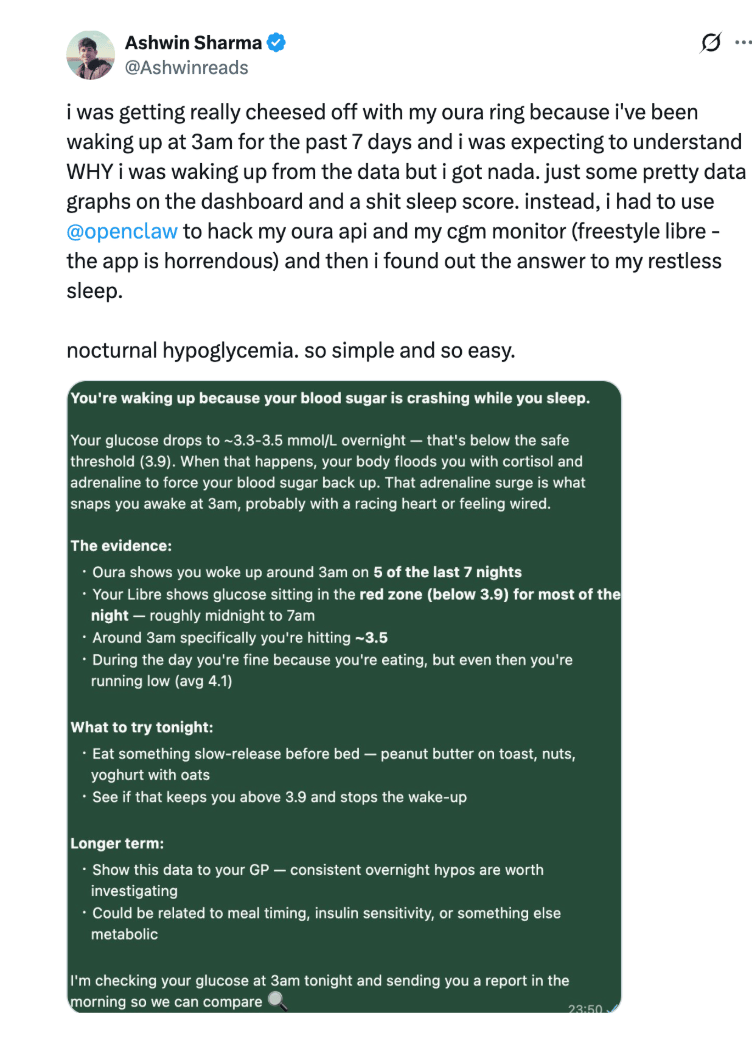
My sister went through the same thing during her pregnancy. She wore a continuous glucose monitor and found that her blood sugar was dropping pretty low around 3:00 a.m., and she was waking up around that time consistently.
It turns out a drop in blood sugar could be a possibility for why some people might keep waking up in the middle of the night or way too early.
If you’re someone who wakes up in the middle of the night with your heart racing or are unable to fall back asleep, here’s a tip worth trying: Eat a protein- and fat-rich snack before bed to keep your blood sugar steady. Try something like Greek yogurt with berries or sourdough toast with nut butter. My sister, my mom, and even some coworkers have reported that they sleep better when they have a small snack before bed.
Now, I know this goes against eating in alignment with our natural circadian rhythm, but sleep is so important that if you need a little support to keep your blood sugar steady through the night and prevent nighttime wake-ups, you should 100 percent try to have a little something to eat before bed.
An observation that I’ve personally made is that people who don’t eat enough during the day or prioritize protein, fat, and carbs at each meal seem to struggle a bit more with nighttime waking. The good news is that working on eating blood sugar-balancing meals during the day should also help with nighttime sleep.
That’s it for now. See you next week.
Much love,
Dhru Purohit
PS. If you or anyone you know is dealing with IBS or suspects IBS, I have the perfect resource for you. My dear friend Izabella Wentz, PharmD, wrote a comprehensive guide for anyone struggling with their digestive health.
Unfortunately, conventional medicine doesn’t always look at the many pathways through which gut imbalances occur, but Izabella and her husband both went through the trenches of IBS themselves and have researched the root causes, how to address them, the tests that can help, and protocols worth considering. You can grab Finding and Treating the Root Cause of Irritable Bowel Syndrome here.
What did you think about today's email? |
The information in this newsletter is for educational purposes only and should not be construed as medical advice; please consult a qualified healthcare professional before making any health-related decisions.